AI
Digital Products
AI Can Write Code: So Why Is Software Delivery Still Broken?

Arionkoder

Takeaways
AI code generation made writing code faster, but it pushed the cost downstream—an estimated $12,000 per developer, per year in revisions, debugging, and security overhead. The real bottleneck in software delivery is no longer the code; it's fragmented context.
Two-thirds of companies already use AI in software development, but only 5% see measurable value at scale (BCG). The gap closes with governed AI-native delivery, with a traceable AI implementation process, not adding more tools.
Sokuvo, Arionkoder's context orchestration system, unifies intent, decisions, and code across the delivery cycle, cutting delivery cycle time by 60% with 100% traceable decisions, the backbone for continuous delivery.
The real bottleneck now is context: teams deal with fragmented context, spend time reviewing and debugging, and struggle to trace decisions. Sokuvo, Arionkoder’s delivery system, is designed to address this.
Turning the Lights On in Autonomous Delivery
Back in the twentieth century, a production system that changed the world. At that moment, humans guided machines all the way through the assembly line. These days, machines can figure out how to move on their own with the right context. So, still, we’re the ones with the opportunity to set the pace.
In a recent blog post, we discussed AI trends for 2026 in business, including the projection that 80% of organizations will evolve into smaller, AI-augmented software teams by 2030. Here, we explore how we build that near future.
Why Writing Code Faster Is No Longer Enough
What’s happening in software delivery today? AI-powered code generation can cause teams to lose time in revisions, debugging, and security overhead. This results in an estimated hidden cost of $12,000 per year.
The focus used to be on accelerating code writing. Just chasing that speed caused some effects to be overlooked. For example, teams are now dealing with security vulnerabilities (from code that looks fine but isn’t) or with long rework tasks due to context fragmentation. And that’s not it, they face higher debugging costs because of subtle errors that scale, and a higher coordination tax (meetings, approvals, status cycles, and every communication line that you already know).
These examples highlight the real bottleneck the industry is facing today, which is, unsurprisingly, about context. Companies are dealing with outdated documentation, decisions stored in chat threads, and reasoning lost between handoffs.
AI coding assistants can’t solve that. They lack a clear understanding of the project's reality, and their outputs require extensive correction (as we can see today). And correction leads to another problem: absent evaluation discipline, there are no behavioral scenarios, and they still miss valuable context.
Overcoming the context bottleneck requires more than technology. Success comes from combining the right tools with clearly defined roles, new AI-native processes, and a curiosity-driven builder mindset. For example, developers today should be able to manage AI agents, write specifications, evaluate outputs, and take ownership of architecture decisions, not just write or review code.
What Companies Need for Continuous Delivery
Two-thirds of companies are using AI in software development, but only 5% report measurable value at scale. You must be wondering what it takes to be in that 5%. Well, teams ship faster with fewer coordination issues, making delivery continuous and more autonomous.
For that, a change in mindset and operations is needed. Companies should move from fragmented AI adoption toward a governed delivery process at scale. First, we all have to unify the context. We have to think of a shared, versioned backbone that keeps pace with decisions, requirements, code, and conversations in one place. All preserving intent across the delivery cycle, which means never losing sight of what we’re trying to address with AI and why.
And since teams don’t need just another tool, we must embed that backbone into their workflow. This way, nobody wastes time manually updating documentation. Another waste of time is constantly asking, "Where does this decision come from?" So, the solution must be fully traceable and governed, with outputs that are auditable and source-linked.
This approach bridges the operational gap among PMs, engineers, specifications, tickets, code, and outcomes. A solution that works today while laying the foundation for greater autonomy over time.
Sokuvo: AI for Continuous Delivery

To embrace the approach we were discussing, there’s no need to overpromise fully autonomous delivery or generic coding pilots. Sokuvo, Arionkoder’s solution for fragmented context, addresses that. Actually, its name says it all: Soku (Japanese: Speed) + voro (Latin: To devour) = A tool that devours tasks at high speed.
Unifying context with Sokuvo leads to a 60% reduction in delivery cycle time. It reduces the coordination tax and drives to fewer review bottlenecks (the problem we were discussing earlier), 100% traceable decisions across delivery (so teams can easily see why someone made a decision), and higher implementation quality.
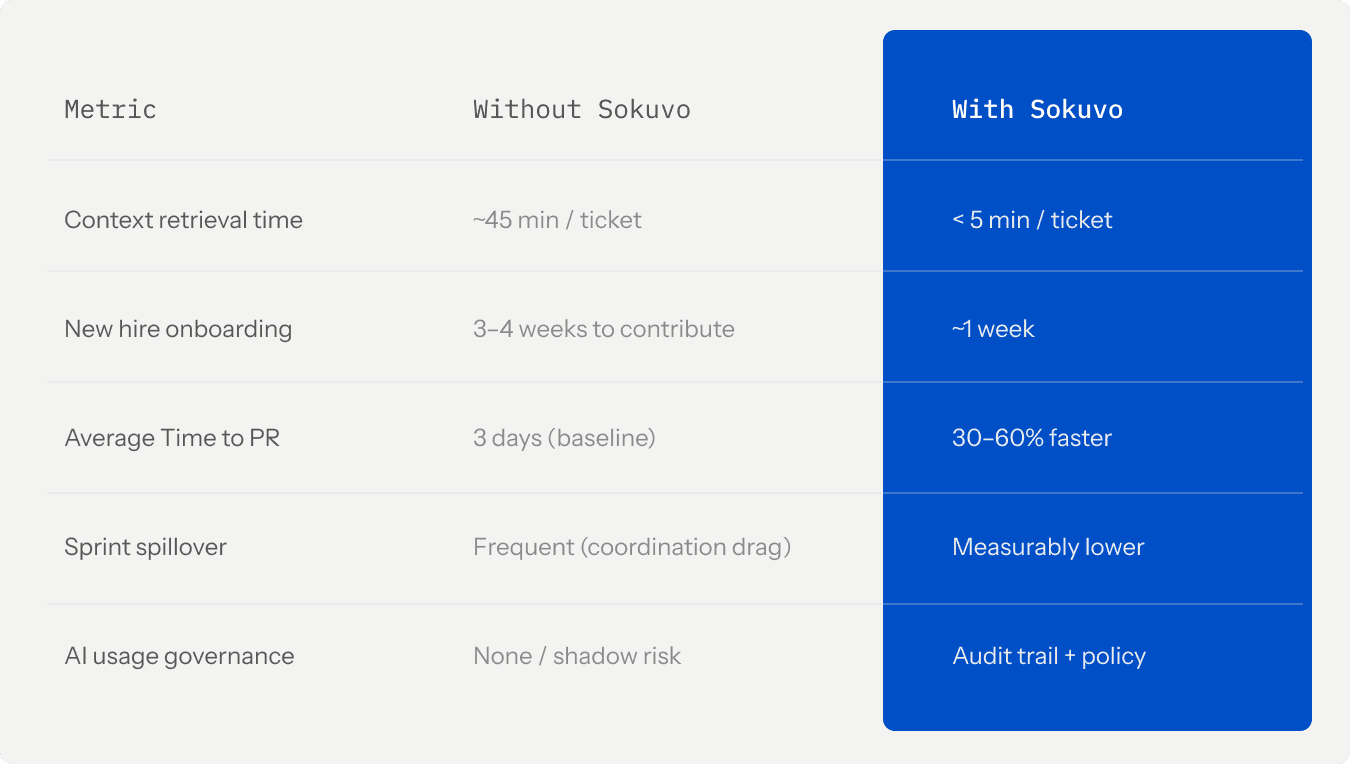
How does it work? Sokuvo is the context orchestration system that connects intent, decisions, and implementation across the software assembly line (spec, plan, build, review, and ship). It keeps execution aligned through a shared context, making delivery faster but also more reliable and predictable.
Plus, teams don’t need to add all the information to a new tool because Sokuvo directly embeds in the tools they’re already using (chat platforms, design tools, code repositories) to take it in.
This AI-powered delivery system fixes the system-level gap between AI-assisted coding and reliable software delivery. Sokuvo meets the need to leave faster coding behind and focus on shipping with continuous flow, connecting all the pieces.
Sokuvo is now available in a private beta version.


Get Started
Ready to make AI useful?
Resources
