
AI
Digital Products
AI Implementation That Compounds: How Arionkoder's IP Engine Works

Arionkoder

Key Takeaways
Frontier models are no longer the differentiator. Every company can access the same ones, so what sets a business apart sits underneath them, in the context, governance, and standards that make a model work differently for that business.
Advantage only compounds if you own it. Context that lives in a vendor's system, or in the head of someone who leaves, resets to zero.
The Foundry is our compounding IP engine. Research and Development, Innovation, and Delivery run as a continuous loop, so every AI implementation starts from what previous cycles already built and tested.
AI governance becomes an advantage when it's continuous. A certification from a point in time narrows as everyone reaches the same bar. T.R.U.S.S. Compass monitors a live compliance position against regulations that keep moving.
The measure of an AI consulting firm is what stays when it leaves. The context layer in your tenant, the governance patterns in your systems, and the standards your teams work by. When partnering with us, the capability stays after we're gone.
What would you call this AI year? "Highest productivity" or, paraphrasing a well-known song, something more like "All you need is a value shift"? There are four more months to go, but the set is pretty clear. While some are telling a nice-to-hear story about automation and productivity, the real one lives in shifting and capturing value pools.
Since frontier models are at hand to any company, they can't be what sets you apart. What sets you apart is underneath them, in whatever makes that model work differently for your business. That layer is the one that compounds, because it accumulates every time you use it. And here’s the thing: it only accumulates if you own it. Context that lives in a vendor's system, or in the head of someone who leaves, resets to zero. So to capture value pools, you have to start compounding, and that starts with ownership and governance.
But how can your company get there? In this blog, we’ll explain how we built our compounding engine, its results, and what it means for an AI implementation that has to keep working after we leave.
The Foundry: how every AI implementation makes the next one faster
A compounding IP engine is an operating structure where every engagement leaves reusable assets and knowledge behind: frameworks, tooling, governance patterns, retained context, you call it. With it, every engagement, every new project, starts further along than the one before it.
We call our engine The Foundry, and it’s the way we operate, and it makes us turn AI ideas into production-ready capabilities, faster and more reliably with each delivery. If you partner with us, that has one direct benefit.
When a company hires us, the team doesn't start from zero, and neither do the products. Both start from what Research and Development, Innovation and Delivery (the three layers on which The Foundry works) have already built and tested. The compounding is ours, but the head start is theirs.
In most AI services firms, the intelligence an engagement produces lives in whoever was staffed on it. It leaves when they leave, and the company that hired the AI consulting firm has no way to compound.
Three layers in a continuous loop
The Foundry has three layers:
Research and Development produces capability ahead of demand, it expands what is technically possible by exploring frontier capabilities and turning them into reliable building blocks.
Innovation transforms insights from real projects into frameworks, tools, and accelerators that improve how we deliver.
Delivery builds scalable, trustworthy systems for real workflows, strengthened by reusable assets.
Read in that order, it describes any firm with a lab attached. The difference is the return. What Delivery learns goes back to Research and Development, and the loop starts again, they never stop working, and they integrate with each other.
This return leg is what almost nobody builds, because it will give, at some point, the power to someone else. It's also what makes the structure hard to copy. A competitor can stand up the same three layers next quarter. What they can't stand is the record of cycles already run, and the work we’ve already done.
The compounding IP city
We like to explain this compounding engine as a city. So, let’s picture the first cycle (that happened a long time ago), mainly made with just raw knowledge: just a single vehicle on an empty road. It goes from A to B. The second cycle finds a road already there, so it goes further. Every cycle after that leaves more behind, and what accumulates is infrastructure: a street, then a grid, then a city that works. The vehicle never gets faster on its own. The city, the compounding elements, do the work
The next and every cycle that follows starts from the city. Less discovery, fewer solved problems solved again, governance patterns that already exist rather than being invented per project.
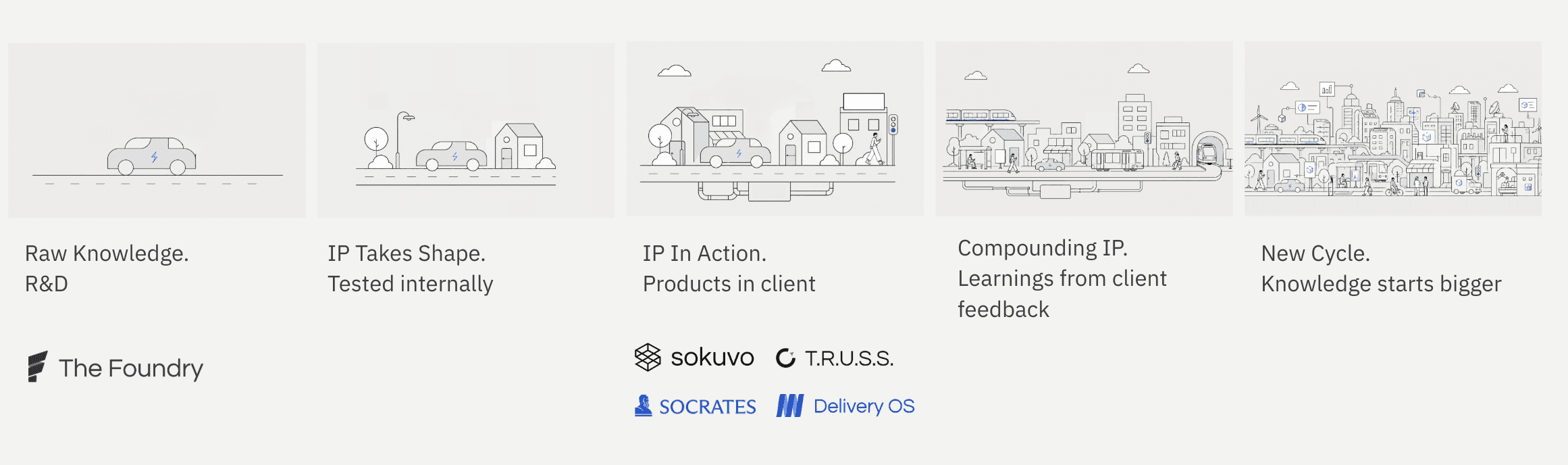
The result of compounding: AI governance and context underneath the tools you already use
None of what we create replaces something a client already runs, because we’re not discussing which model to commit to, we’re going beyond that straight to the value that encapsulates governance and ownership.
Let’s see it with examples of our intellectual property. T.R.U.S.S. Compass reads the repositories teams are already using. Sokuvo connects to the tools already in the workflow and collects the context they generate. Both sit below the toolchain.
That position is what turns bought software into something proprietary. Any competitor can buy the same model. The arrangement underneath (for example, how the data is used to continuously improve a fraud and authorization model) is what can't be bought, and here the client is the one who ends up owning it.
T.R.U.S.S. Compass: continuous compliance monitoring
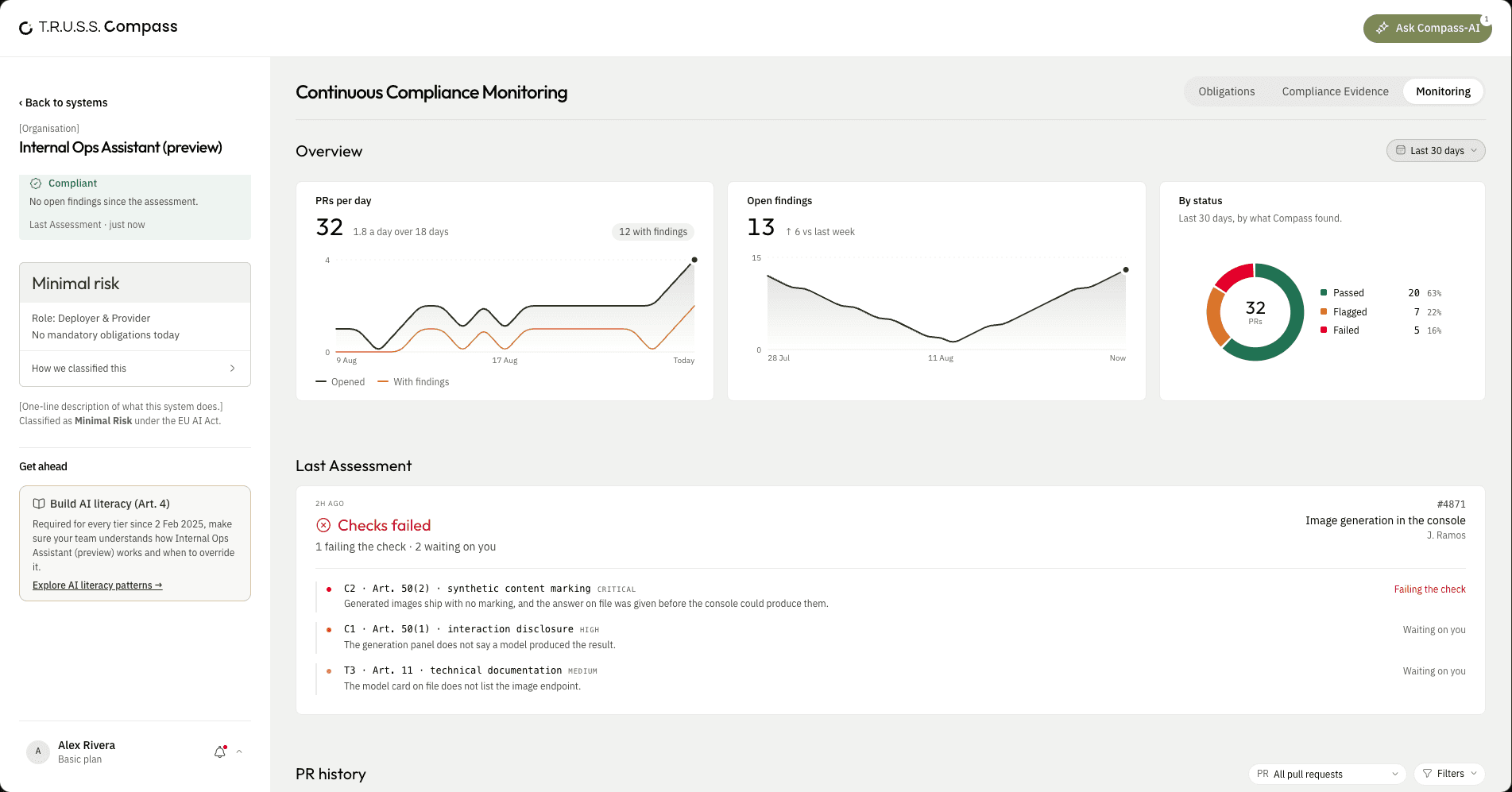
T.R.U.S.S. Compass measures your compliance position continuously against a moving bar: regulations. The EU AI Act is the current example, but it can be any other: GDPR, ISOs around the world, or even a company’s regulation. With T.R.U.S.S. Compass, you bring your code, your architecture, your pipeline, and it extracts every obligation that applies to you and turns it into a live, monitored compliance control. You get flagged when something drifts, and also get a suggested action to solve it.
One distinction is worth making here. Holding a regulatory position is an advantage that narrows as regulation spreads and everyone reaches the same bar. Governance you can verify on demand doesn't narrow, because the bar keeps moving and the verification has to keep up with it. Compass is built for the second one.
Sokuvo: the context layer that carries memory
Sokuvo is our context orchestration system. It's model-agnostic, it runs inside your own tenant, and the context it collects accumulates on your side. You rent the intelligence, you own the memory.
It removes the coordination tax. Every team that joins a project rebuilds the context the last one already had. Sokuvo connects to the tools your teams already use and keeps that context in place, so the next team starts from it instead of reassembling it.
BCG describes this shape of advantage as system-level integration: tools any competitor can buy, arranged into a workflow nobody else has. That arrangement is what Sokuvo builds, and you end up owning it.
Socrates: AI-native operations, and the talent question
AI execution rarely stalls at the technology; it’s more often talent, workflows, and culture. The organisations that struggle will be the ones that can't go beyond AI adoption. And how can you shift to value if you stay at just using a vendor’s AI tool?
That's the part no old-school vendor can install for you. We created Socrates for that, a company-wide initiative that we run for ourselves first and then for your partners. Socrates makes organizations AI-native by changing the operating model around AI, this means: redesigning how teams work, redefining how to measure performance, and using AI to increase business impact.
Delivery OS: ownership, measurable outputs, no bureaucracy
Delivery OS is the operating system for faster, accountable AI delivery. Defined ownership, measurable outputs, and zero bureaucracy from first contact to handoff.
For you, that shows up as a single chain of command, so there's one person accountable for each workstream. Outputs are defined before the work starts, which means progress can be checked rather than reported on. And the checkpoints go before delivery, so problems surface while they're still cheap to fix.
How do you sustain AI transformation without ongoing consulting spend?
You own the layer the transformation runs on instead of renting the team that holds it. The layer is three things: the context, the governance patterns, and the delivery standards.
Three conditions make that real. Context accumulates in your environment rather than a vendor's. Governance is monitored by a system rather than reassessed by a consultant each quarter. Delivery standards are written down as operating practice rather than carried around as a habit.
The engagement still does the work of building that layer. What's no longer there is the dependency. When it ends, what stays is the context layer running in your tenant, the governance patterns encoded in your systems, the standards your teams work by, and the knowledge itself.
When you work with us, the engagement ends and the infrastructure stays, so capability stays with it. That layer is where the value settles. Models will keep leveling out, and what stays underneath them is what you own.
Five questions worth asking about your own stack before anyone sells you a transformation. Does your context survive team turnover? Do your data improve the product as they're used, or only accumulate? Is your governance a certification from a point in time, or a position you monitor? Would a competitor with the same models be six months behind you, or level with you? And if you switched AI vendors tomorrow, what would you still have?
If the answer is "not much", the most valuable layer is being built somewhere else.


Get Started
Ready to make AI useful?
Resources
